Technology · · 3 min read
How Much Does 3D Printing Cost? A Guide for Architectural and Display Models
What drives 3D printing service prices — technology, material, volume, height, supports, finishing and labour — plus how 3D printed architectural models are priced compared with a single 3D print, and how to prepare files.
By the SZT Model project team · Reviewed by David Wang
Short answer: The cost to 3D print something depends mainly on the technology (FDM is cheapest, SLA and SLS mid-range, metal the most expensive), the part's volume and height, support material, the number of parts per build, and post-processing such as sanding and painting. For architectural models the print itself is usually a minority of the cost: design preparation, finishing, colouring, landscape, lighting and assembly make up most of the price.
"How much does it cost to 3D print this?" is one of the most common questions any 3D printing service bureau receives. The answer depends far more on the part and its finish than on the printer. Here is what drives the price — and why a 3D printed architectural model is priced differently from a single print.
The seven cost drivers of a 3D print
| Driver | Why it matters |
|---|---|
| Technology | FDM < SLA/DLP ≈ SLS/MJF < PolyJet colour < metal (SLM/DMLS) |
| Material | Standard resins and PLA are cheap; engineering resins, nylon, metals cost more |
| Part volume | Material used and, for powder processes, build space occupied |
| Part height | Resin and powder printers build layer by layer, so tall parts take longer |
| Supports | Extra material and labour to remove and clean up |
| Batch nesting | Many parts in one build share machine time |
| Post-processing | Sanding, priming, painting, polishing, assembly — often the largest share |
Metal 3D printing service costs are higher because of powder prices, inert-gas machines, stress relief and support removal by machining.
Relative cost by technology
| Technology | Relative cost per part | Best for |
|---|---|---|
| FDM | Low | Concept massing, jigs, large rough forms |
| SLA / DLP (resin) | Medium | Facades, fine detail, smooth surfaces |
| SLS / MJF (nylon) | Medium | Durable parts, complex internal geometry |
| PolyJet / full colour | High | Colour prototypes, small presentation models |
| Metal | Very high | Functional metal parts, jewellery-scale detail |
Why an architectural model costs more than its prints
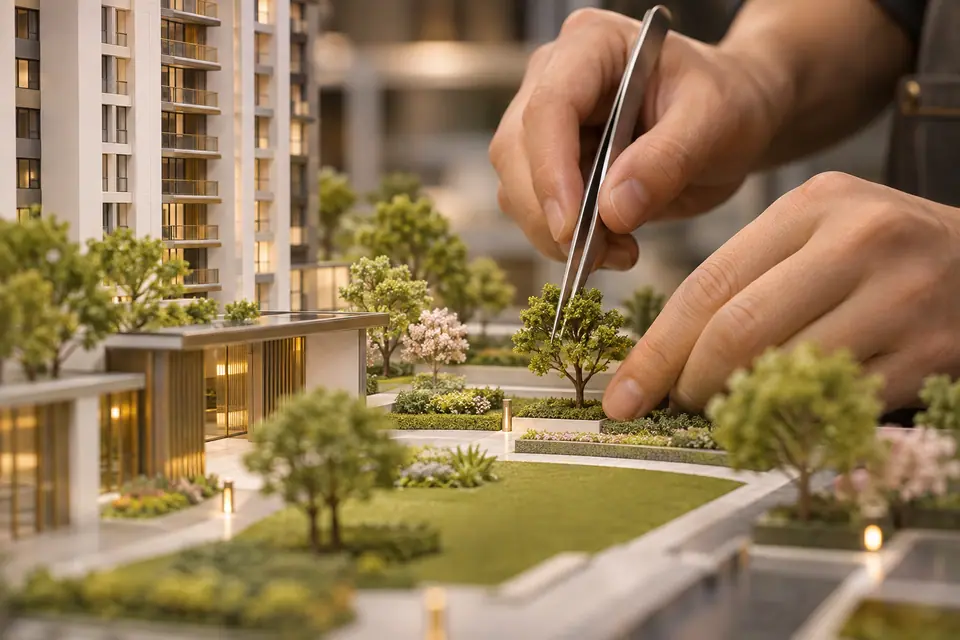
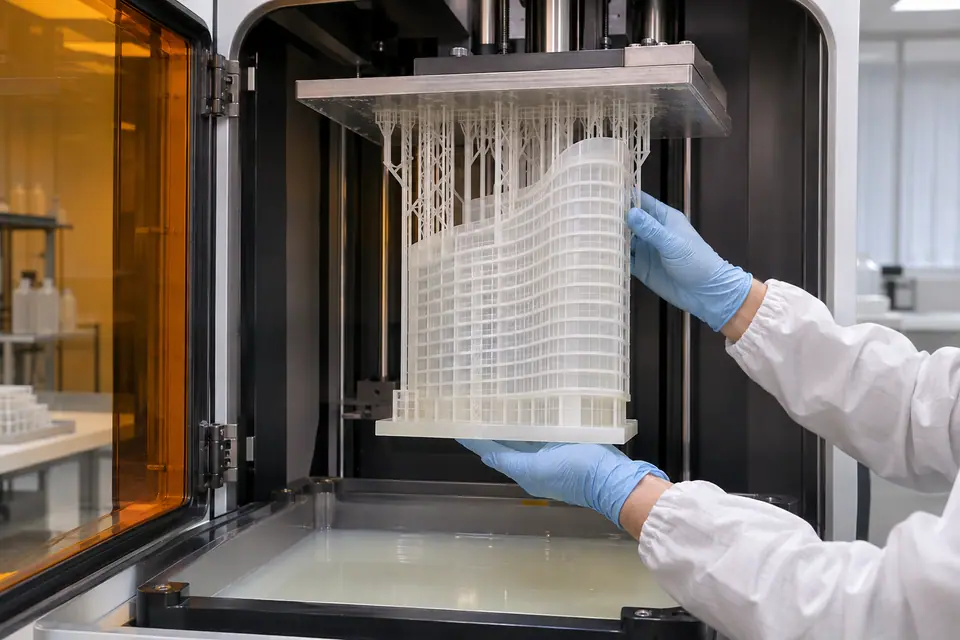
A 3D printer for architectural models produces raw parts: a tower, a facade panel, a roof. A presentation model still needs:
- File preparation: turning architectural BIM into watertight, printable, correctly scaled parts
- Finishing: removing layer lines so facades look like glass and stone, not plastic
- Colour: spray painting and colour matching to material samples
- Base and site: CNC or UV-printed bases, roads and terrain
- Landscape, people and vehicles
- Lighting, wiring and testing
- Assembly, crating and shipping
That is why our cost guide prices models by scale, detail, landscape and lighting rather than by grams of resin. For when to print and when to machine, see 3D printing vs CNC.
Preparing your own 3D print files
- Export a closed (watertight) mesh — STL, OBJ or 3MF.
- Model at the final scale and check minimum wall thickness (around 0.8–1.0 mm for resin at small sizes).
- Remove internal geometry and duplicate faces.
- Split large models into parts that fit the build volume, with keyed joints.
- Send the original 3D file (Revit, Rhino, SketchUp, 3ds Max) as well, so the model maker can fix problems at source.
3D scanning objects — with a structured-light scanner or even photogrammetry from a camera — is a good way to capture existing sculptures, terrain or heritage details for printing.
Frequently asked questions
How much does it cost to 3D print something small?
A small FDM or resin part is usually inexpensive; price rises with size, height, material and finishing. Ask for a quote with your file, material and finish, since bureaus calculate from the actual geometry.
Why is metal 3D printing so expensive?
Metal powders, inert-gas machines, slow build rates, stress-relief heat treatment and machining off supports all add cost, so metal printing is reserved for parts where its benefits justify it.
Can I get just the 3D printed parts of an architectural model?
Yes, some clients order printed and painted buildings only and assemble them locally, but most choose a complete model so colour, base and lighting are controlled together.
What file format do I need for 3D printing?
STL, OBJ or 3MF meshes are standard. For architectural models, also send the source file so walls, scale and detail can be optimised for printing.
Related service
Real Estate Sales Gallery Models — Masterplan sand tables, tower models and landscape models that help buyers understand a development before a single brick is laid.