Guides · · 3 min read
Scale Model Sizes Explained — 1:8, 1:16, 1:24, 1:32, 1:64, 1:72 and Architectural Scales
What scale model ratios mean and how big models really are: car, figure and vehicle scales (1:8 to 1:87) side by side with architectural scales (1:20 to 1:5000), with conversion tables in centimetres and inches.
By the SZT Model project team · Reviewed by David Wang
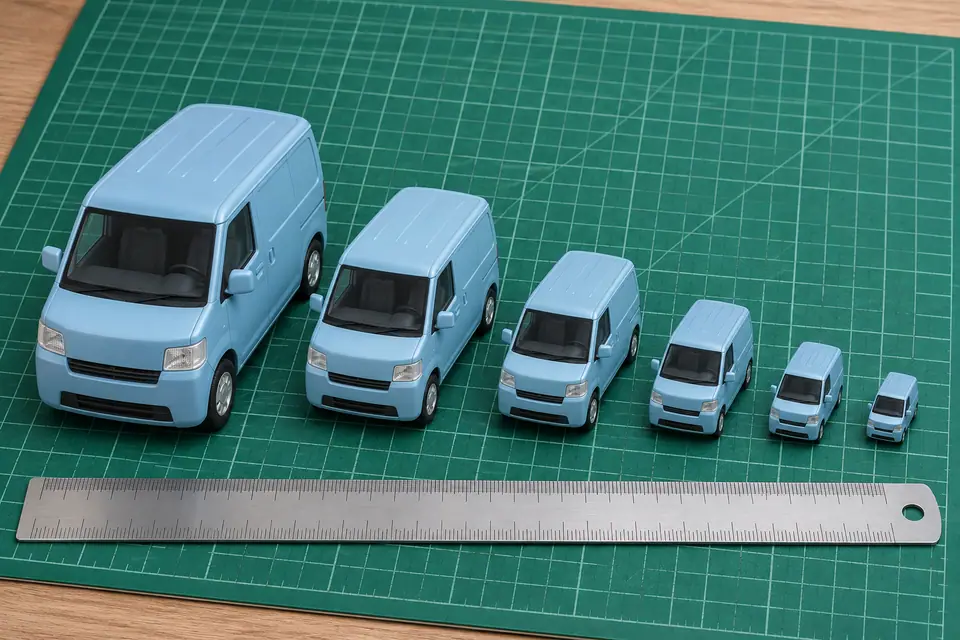
Short answer: A scale model ratio such as 1:32 means every unit on the model represents 32 of the same units in reality, so a 4.5 m car is about 14 cm long at 1:32, 19 cm at 1:24, 25 cm at 1:18 and 7 cm at 1:64. Hobby scales (1:8 to 1:87) are used for vehicles and figures; architectural models use rounder ratios from 1:20 for interiors to 1:5000 for whole cities.
Model scales confuse people because two worlds use them differently. Collectors talk about 1:18 and 1:64 cars; architects talk about 1:100 and 1:500 buildings. The maths is the same — and once you see the numbers side by side, choosing a scale becomes easy.
Definition of a scale model
A scale model is a physical replica whose every dimension is reduced (or enlarged) by the same ratio. At 1:24, 1 cm on the model equals 24 cm in reality. The larger the second number, the smaller the model.
Model size = real size ÷ scale number.
Vehicle and figure scales
| Scale | 4.5 m car | 1.8 m person | Common uses |
|---|---|---|---|
| 1:8 | 56 cm | 22.5 cm | Large kits, statues, "1/8 scale figures" |
| 1:12 | 37.5 cm | 15 cm | Premium car replicas, dollhouses |
| 1:16 | 28 cm | 11.3 cm | Tanks, trucks, military figures |
| 1:18 | 25 cm (≈9.8 in) | 10 cm | Popular diecast car scale |
| 1:24 | 19 cm (≈7.4 in) | 7.5 cm | Plastic kits and diecast cars |
| 1:32 | 14 cm (≈5.5 in) | 5.6 cm | Diecast cars, farm and slot cars |
| 1:43 | 10.5 cm (≈4.1 in) | 4.2 cm | Collector cars |
| 1:50 | 9 cm | 3.6 cm | Construction machinery and trucks |
| 1:64 | 7 cm (≈2.8 in) | 2.8 cm | Small diecast cars |
| 1:72 | 6.3 cm (≈2.5 in) | 2.5 cm | Aircraft and military kits |
| 1:87 (HO) | 5.2 cm | 2.1 cm | Model railways, architectural figures |
1:72 in inches: 1 inch on the model equals 72 inches (6 feet) in reality. 1:64 in inches: 1 inch equals 64 inches (5 ft 4 in).
Architectural model scales
| Scale | 30 m (10-storey) building | Typical model |
|---|---|---|
| 1:20 – 1:50 | 60 – 150 cm | Interiors, unit models, construction details |
| 1:100 | 30 cm | Single buildings, facades |
| 1:200 | 15 cm | Towers, small masterplans |
| 1:500 | 6 cm | Residential masterplans |
| 1:1000 | 3 cm | Districts |
| 1:2000 – 1:5000 | 6 – 15 mm | Cities and regions |
Detail drawings are typically drawn at large scales — 1:1, 1:2, 1:5 or 1:10 — because they show how components fit together; general arrangement drawings use 1:50 to 1:200.
For choosing an architectural scale by table size and viewing distance, read our architectural model scale guide or use the model size calculator.
Why vehicles appear in architectural models
People and cars give a model its sense of size. Architectural models usually use figures and vehicles at exactly the model's scale — 1:100, 1:150, 1:200 — while railway-scale accessories (1:87, 1:160) are sometimes borrowed for models near those scales. More on that in HO and N scale buildings.
Frequently asked questions
How big is a 1:64 scale car?
About 7 cm (2.8 inches) long for a typical 4.5 m car. Small cars are closer to 6 cm and large SUVs or pickups 8 cm or more.
How big is a 1:24 model car?
A 1:24 model of a 4.5 m car is about 19 cm (7.4 inches) long.
What size is a die-cast 1:32 car?
A 1:32 die-cast car of a 4.5 m vehicle is about 14 cm (5.5 inches) long.
How tall is a 1:8 scale figure?
A 1.8 m person at 1:8 is 22.5 cm (about 9 inches) tall.
What is the difference between 1:16 and 1:18 scale?
1:16 models are about 12.5% larger than 1:18 models of the same subject. A 4.5 m car is about 28 cm at 1:16 and 25 cm at 1:18.
Related service
Real Estate Sales Gallery Models — Masterplan sand tables, tower models and landscape models that help buyers understand a development before a single brick is laid.