Guides · · 3 min read
Museum and Exhibition Models — Landmark Replicas, Heritage Models and Kinetic Displays
How museums, visitor centres and corporate exhibitions commission architectural models of landmarks, heritage sites and museums themselves: scale, accuracy, durability, interactivity and conservation-friendly materials.
By the SZT Model project team · Reviewed by David Wang
Short answer: Museum and exhibition models are built for years of public display, so they combine archival-quality accuracy with durable materials, protective acrylic covers, serviceable lighting and often interactive or kinetic features. Landmark replicas are usually 1:50 to 1:500 depending on the building's size, and heritage models are researched from drawings, surveys and photographs.
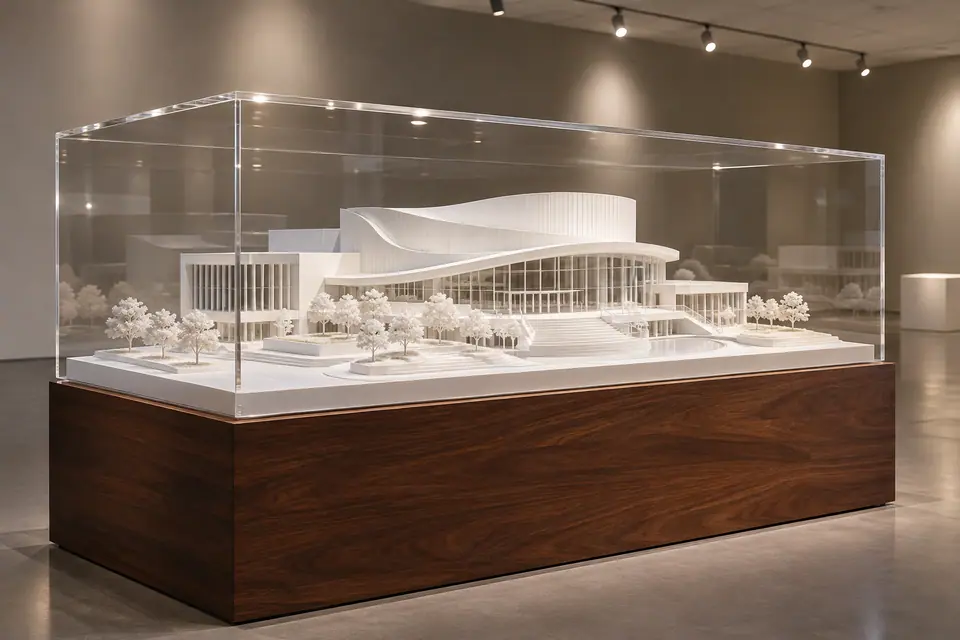
Museum models have a harder life than sales models. They stand for years, face thousands of visitors a day and must be accurate enough for historians and engaging enough for children.
What museums commission
| Model | Purpose | Typical scale |
|---|---|---|
| Landmark replica | Show an iconic building in full | 1:100 – 1:500 |
| Heritage reconstruction | Recreate a lost or altered building | 1:50 – 1:200 |
| Model of the museum itself | Orientation, architecture story | 1:100 – 1:300 |
| Section or cut-away model | Explain structure and construction | 1:50 – 1:100 |
| City or site model | Context of a historic district | 1:500 – 1:2000 |
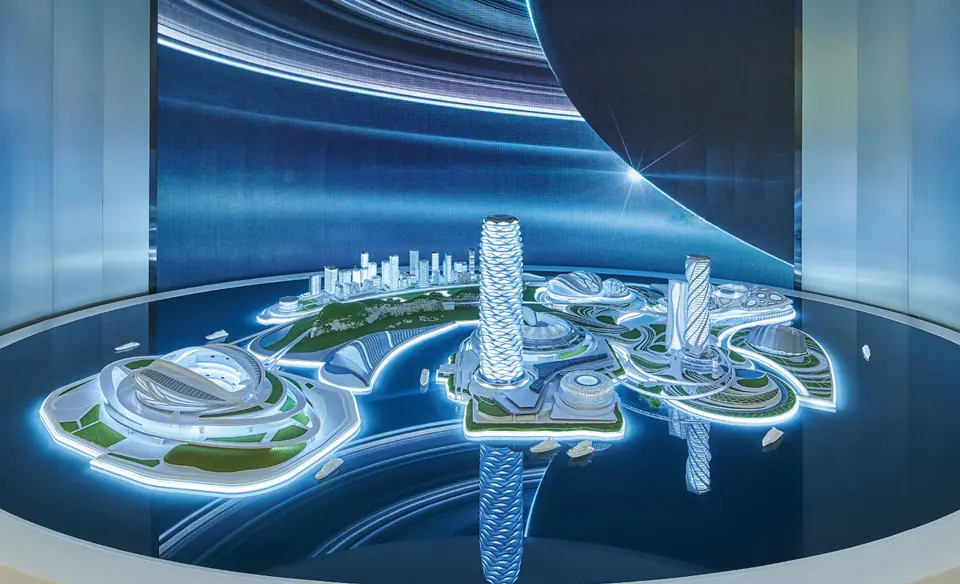
| Kinetic model | Moving facades, opening roofs, construction sequences | Project-specific |
Accuracy and research
Heritage models start with research: measured drawings, archive photographs, laser scans and expert review. We build a 3D reconstruction, agree uncertain details with the curator, and document sources so the model can be explained on the label.
Built for years on display
- Materials: UV-stable acrylic and paints, sealed bases, low-outgassing adhesives where models sit near artefacts.
- Covers: custom acrylic or low-iron glass vitrines — see display cases for scale models.
- Lighting: LEDs with drivers accessible from the base, rated for long daily operation.
- Kinetics: industrial motors and controllers sized for continuous duty, with maintenance access.
- Interactivity: buttons, touch screens and projection that survive constant use.
Corporate exhibition halls
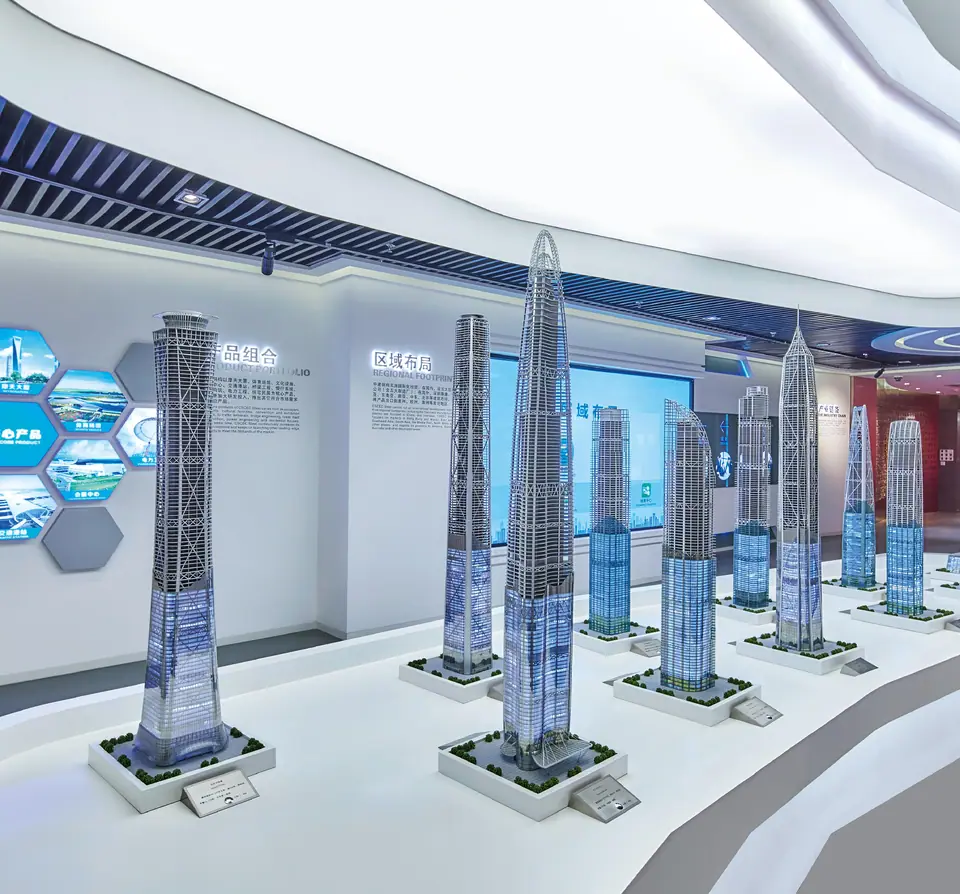
Companies and state-owned groups build exhibition halls that tell their story through several models: headquarters, flagship projects, factories and future plans. SZT Model has delivered exhibition-hall programmes for clients such as CSCEC and Yanlord — see CSCEC Exhibition Hall, Yanlord Exhibition Hall and Fosun Foundation Art Center, where our mechanics department built the moving tube curtain as a working kinetic facade.
Mini architectural models for shops and gifts
Small landmark replicas for museum shops or corporate gifts are a different product: simplified, often 3D printed or cast in small batches, with packaging. We can produce masters and small runs for these.
Frequently asked questions
What scale should a museum model of a landmark be?
It depends on the building and the space: large landmarks are often 1:200 to 1:500, smaller buildings 1:50 to 1:100. The key is that visitors can read the main architectural features from the barrier line.
How long does a museum model last?
With UV-stable materials, a sealed acrylic cover and serviceable lighting, a well-built museum model lasts decades; lighting components may need replacement over that time.
Can a museum model move or be interactive?
Yes. Kinetic models can open, rotate or show construction sequences, and touch screens or projection can highlight parts of the building.
Can you reconstruct a building that no longer exists?
Yes, from archive drawings, photographs and expert input. Uncertain details are agreed with the curator and documented.
Related service
Cultural, Landmark & Kinetic Models — Museum-grade models of landmark buildings, moving facades and brand exhibitions, built to be looked at for years.